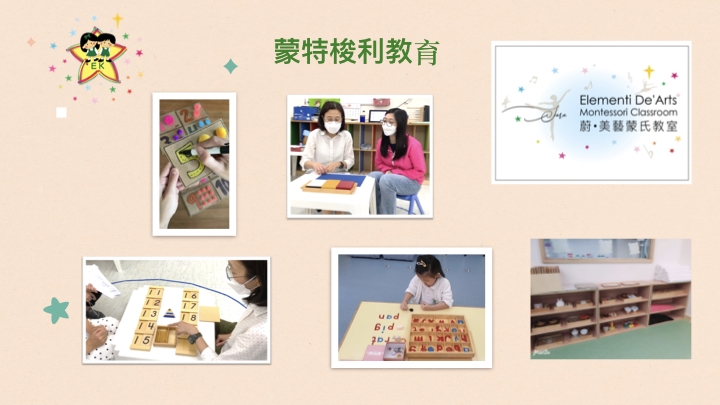

Amazing World of Montessori Teaching Method
"The senses, being explorers of the world, open the way to knowledge.”Dr Maria Montessori said.
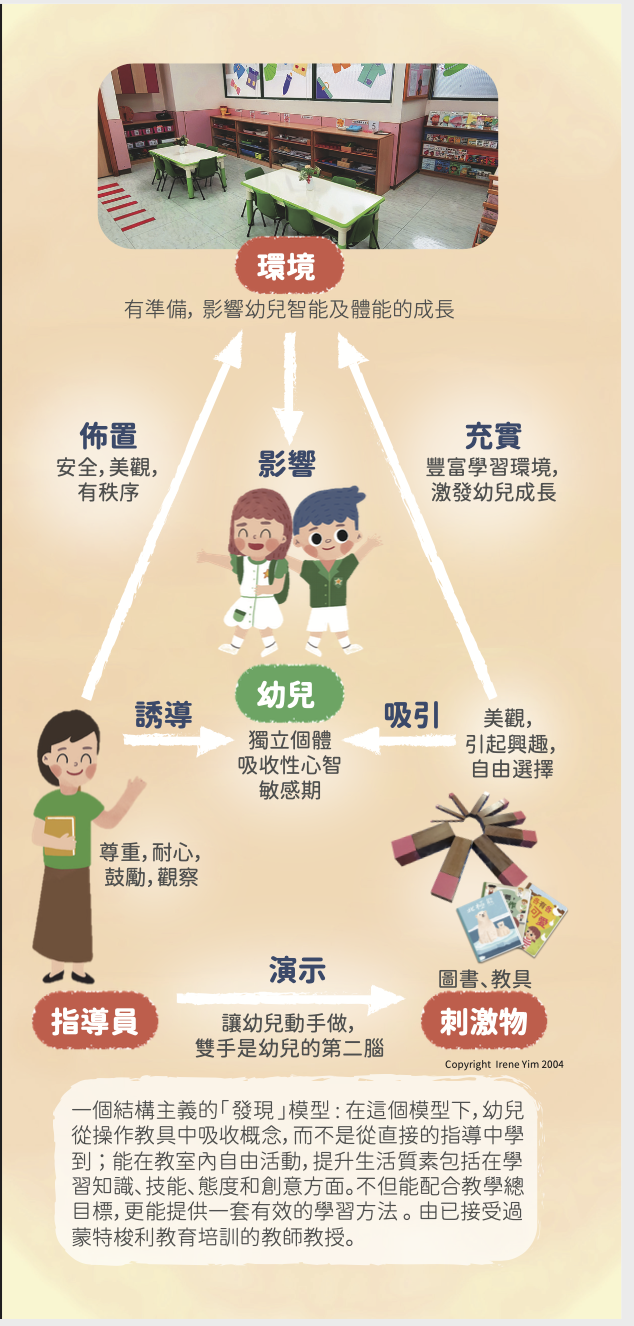
Montessori Learning Environment allows children to learn according to their developmental stage. Through interaction to enhance children’s exploratory power, memory skills and social ability. Besides, it aims to help children build up self-confidence, discipline and attain good emotional learning. It upgrades the quality of life comprehensively, includes domains like knowledge, skills, attitudes and creativity. Not only can it meet the overall goal of teaching, but also provide an effective learning method.
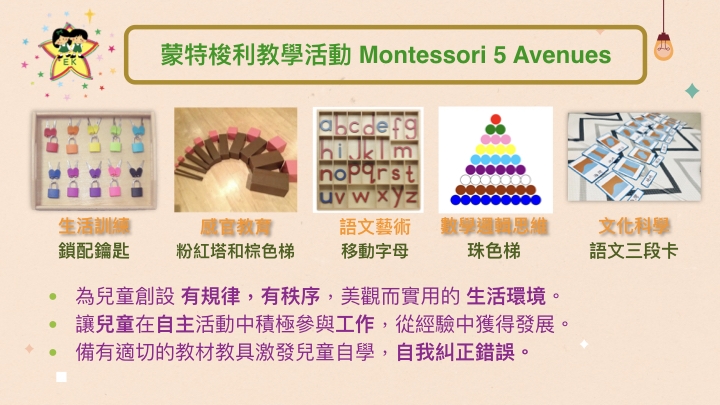
Six Avenues of Montessori Education
-
Life Skills Training (Practical Life)
Through meaningful activities in everyday life, children learn self-care, cooperation, and problem-solving skills. These abilities strengthen their independence while helping them find a sense of achievement in daily routines. -
Sensory Learning and Cognition
Using a variety of sensory materials, children explore different textures, colors, shapes, and sounds. This supports their observation and cognitive development, helps them better understand the world around them, and also builds a strong foundation for future learning. -
Language Arts
Through stories, songs, and interactive activities, children develop their language skills. This includes expanding vocabulary as well as building abilities for expressing emotions and communicating—helping children approach social situations with confidence. -
Mathematics and Logical Thinking
With concrete learning materials and hands-on games, children develop mathematical thinking through counting, categorizing, and sorting. These activities deepen their understanding of math concepts and strengthen their problem-solving abilities. -
Culture and Science
Children are introduced to basic ideas from diverse cultures and natural sciences. This helps them understand and respect different cultural backgrounds, while nurturing curiosity about the natural world and encouraging a spirit of exploration. - Interesting Orff “Music Childhood”
Through music education, children are enabled to develop happiness, self-confidence, imagination, creativity and expressiveness. It opens up full body, whole-hearted and whole-brain activities to lead children to experience literary, life, cultural, creative lifestyles and aesthetics. In the process of learning, children undergo "attempts" and "deeds" while receiving music education. It inspires children's multiple intelligences through body percussion, dialogue, rhythm, singing, dance and instrumental ensemble. It also includes music, art, bodily kinesthetic intelligence, interpersonal, language, mathematical logic, space, natural observation and personal introspection, allowing students to develop various kinds of potentials:
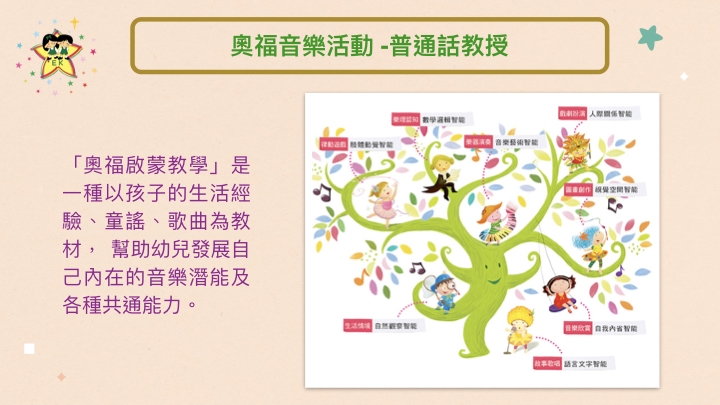
Music & Arts Intelligence
Overall Expectation
We hope that a Montessori learning environment will promote well-balanced development across all areas for young children. Through exploration, children will discover who they are and gradually build a foundation for lifelong learning. With this teaching approach, children will not only gain knowledge and experiences, but also learn how to apply what they’ve learned in everyday life—developing a positive and forward-looking attitude toward living.
Ultimately, we aim for every child to thrive in such an environment, becoming a global citizen with independence and creativity.